

Social Security and Taxes: What Every Retiree Needs to Know
Retirement should be about freedom—doing what you want, when and how you want. But the reality for many pre-retirees and retirees is a mix of confusion, tax surprises, and concern about how to make the most of Social Security while keeping more of what they’ve worked a lifetime to earn.
At J-Ensley Financial, our goal is to remove the anxiety and give you the clarity you deserve. With thoughtful planning, you can enjoy a predictable income, minimize taxes, and protect your lifestyle throughout retirement.
Accumulation vs. Distribution: The Retirement Shift
Most financial planning focuses on the accumulation phase: saving into a 401(k), IRA, or investment portfolio. But once you retire, the game changes.
Now, you’re in the distribution phase, and the rules are different. How you draw income matters more than ever. Market losses, poor withdrawal timing, and high taxes can cause your retirement savings to deplete much faster than expected.
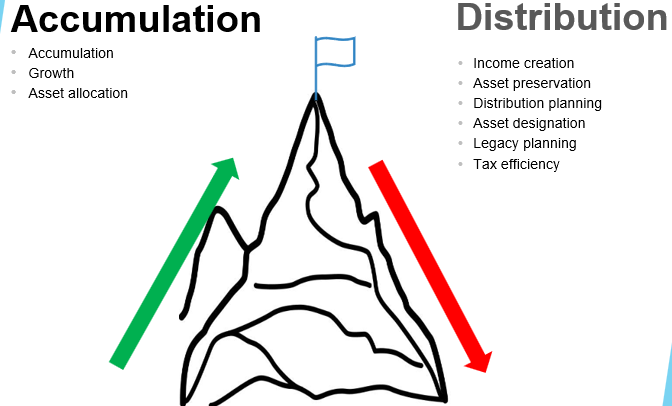
Sequence of returns risk means that losing money early in retirement can have a devastating, irreversible impact. Smart withdrawal strategies, account diversification, and tax efficient strategies are your new superpowers.
Guaranteed Income: Your Retirement Foundation
One of the best ways to manage income risk is to create guaranteed income streams that aren’t dependent on the market.
This includes:
Social Security
Pensions
Annuity Income
Rental or Business Income
Whole Life Insurance Cash Values
Social Security, in particular, is a foundational guaranteed income source. It’s predictable and inflation-adjusted, and it plays a crucial role in every retirement plan we design.
Understanding Social Security Basics
To qualify for Social Security retirement benefits:
You need 40 credits, or about 10 years of full-time work.
You can file as early as age 62, but waiting increases your benefit.
Your Full Retirement Age (FRA) depends on your birth year (usually age 66 or 67).
Delaying benefits until age 70 increases your payout by up to 32%.
Spousal and survivor benefits provide additional options, but the rules are complex. The right strategy can add tens of thousands to your lifetime income.
When Should You File for Social Security?
There’s no one-size-fits-all answer. The “best age” depends on your income needs, health, longevity expectations, and whether you’re married. Filing early means lower checks forever; delaying increases benefits, but you must bridge the income gap.

The Social Security Administration doesn’t give personalized advice. That’s where we come in. We use software and strategy to tailor your filing decision to your life.
Can You Work and Still Collect Social Security?
Yes, but there are income limits if you claim benefits before your FRA:
Under FRA (2025): $1 withheld for every $2 earned over $23,400.
FRA year (2024): $1 withheld for every $3 earned over $62,160.
After FRA: No limit on earnings.

The good news? Withheld benefits are not lost forever; they can be credited back after you reach full retirement age.
Social Security and Taxes: The Provisional Income Trap
Here’s the surprising part: up to 85% of your Social Security can be taxed. This is based on a formula called provisional income:
Provisional Income =
50% of your Social Security benefits +
All ordinary income (IRA withdrawals, wages, pensions, etc.) +
Dividends and Capital Gains +
Tax-exempt interest (like municipal bond income)
For married couples filing jointly:
Under $32,000: 0% of SS taxable
$32,001–$44,000: Up to 50% taxable
Over $44,000: Up to 85% taxable
Most retirees are shocked to learn how their income sources interact to trigger tax on their Social Security.


Strategic Withdrawals: The Tax-Efficient Retirement
Choosing which accounts to pull from and in what order can make or break your retirement tax strategy.
Withdraw only from IRAs or 401(k)s, and more of your SS becomes taxable
Withdraw from Roth IRAs or cash value life insurance, and you may reduce or eliminate taxes on Social Security
Blended strategies can optimize income and minimize lifetime taxes
We show clients how to combine income sources strategically to reduce tax drag and keep more spendable income.
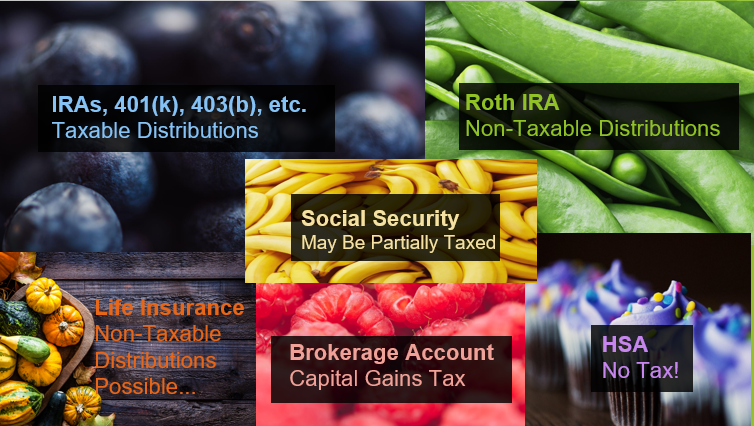
The Power of Tax Diversification: Account Type Matters
A tax-efficient retirement relies heavily on the diversity of your account types. Different accounts are taxed in different ways, and leveraging this variety gives you powerful flexibility in planning.
Here are the key account types to know:
Traditional IRAs / 401(k)s / 403(b)s: Pre-tax contributions; fully taxable at withdrawal as ordinary income
Roth IRAs and Roth IRA Annuities: Funded with after-tax dollars; qualified withdrawals are tax-free and not counted in the provisional income formula.
- Roth IRA Conversions: Did you know you can convert a taxable retirement account into a non-taxable Roth IRA account or Roth IRA Annuity? Yes, you can, but there are some rules to be aware of. Set up a free strategy session with John to learn more and find out if Roth Conversions might be a good strategy for you.
Health Savings Accounts (HSAs): Triple tax advantage if used for medical expenses
Brokerage Accounts: Taxed on capital gains and dividends; some flexibility depending on how gains are realized
Cash Value Life Insurance: Withdrawals (structured correctly) are income-tax-free and do not count toward provisional income
Having a mix of these accounts allows you to choose where to pull income from year to year, helping you manage your provisional income calculation to avoid stealth taxes, reduce taxable Social Security, and stretch your retirement dollars further.

Understanding Roth IRA Conversions
What Is a Roth IRA?
A Roth IRA is a retirement savings account that allows for tax-free withdrawals in retirement. You contribute with after-tax dollars, and if you follow the rules, all earnings and withdrawals are completely tax-free.
What Is a Roth IRA Conversion?
A Roth IRA conversion is the process of moving money from a tax-deferred account like a traditional IRA or 401(k) into a Roth IRA. You pay taxes on the converted amount in the year of the conversion, but future growth and withdrawals are tax-free.
How Do Roth IRA Conversions Work?
Choose the amount you want to convert
Pay taxes on the converted amount as ordinary income
The money grows tax-free inside the Roth IRA
Future withdrawals (if qualified) are completely tax-free and do not count toward provisional income for Social Security.
Smart conversions are usually done over time to stay within lower tax brackets. We help clients design multi-year conversion plans that minimize tax spikes.
Converting to a Roth IRA Fixed Index Annuity
Did you know you can use your Roth IRA to fund a Fixed Index Annuity? This can provide the safety of principal protection, market-linked growth potential, and guaranteed lifetime income—all tax-free.
Start with a traditional IRA or 401(k)
Convert the amount you want into a Roth IRA (pay taxes now)
Use the Roth IRA to fund a Roth-designated FIA
Enjoy tax-free income for life, with no RMDs and no impact on Social Security taxation
This strategy is powerful for those who want predictable income, downside protection, and tax efficiency in retirement.

Using IRA Funds to Fund a Whole Life Policy
While not technically a Roth conversion, another tax-efficient strategy is to withdraw funds from a traditional IRA (and pay the taxes) to fund a Bank On Yourself-designed whole life insurance policy.
Once funded, the policy grows tax-deferred and offers tax-free access to cash value
It does not count toward provisional income, helping reduce Social Security taxes
No contribution limits, no income limits, and no RMDs
This strategy can replicate many benefits of a Roth IRA without the same restrictions. It also creates legacy protection via the tax-free death benefit.
We can help you analyze which strategy—Roth conversion, Roth FIA, or life insurance—best fits your goals. Click here to set up a free strategy session with John today…
Case Study: Three Withdrawal Scenarios
Let’s say a retired couple needs $92,000 per year in income. They have $34,000 in Social Security, a Roth IRA with $250,000, and a traditional IRA with $750,000.
Scenario 1: Withdraw $58,000 from the IRA
85% of SS is taxable
Higher overall tax bill
Scenario 2: Withdraw $58,000 from the Roth IRA
0% of SS is taxable
No taxes now, but Roth will run out of money in just a few years!
Scenario 3: Split evenly between Roth and IRA
Only ~22% of SS is taxable
Low tax burden and both accounts are sustainable for many years to come.
If this couple had converted more of the traditional IRA to Roth annuities or cash value life insurance, it would have saved them thousands in taxes. This is the power of tax diversity and smart planning.
The Tax Torpedo and Widow’s Penalty
These are stealth taxes that target middle-income retirees:
Tax Torpedo: IRA withdrawals increase taxable SS, which pushes more capital gains into higher brackets—potentially 49.95% effective tax on some withdrawals!
Widow’s Penalty: A surviving spouse often pays double the tax on the same income due to a change in filing status from married to single.
Armed with this knowledge, we can create tax-bracket aware income plans that protect you and your spouse.
Will Taxes Go Up? Most Likely.
We face legislative risk: future laws could increase tax brackets, reduce deductions, or change how Social Security is taxed.
The current law (Tax Cuts & Jobs Act) sunsets in 2025. Without planning, your taxes may rise dramatically in just a few years.
That’s why planning ahead is so important. Strategies like Roth conversions, annuities, and life insurance can help shift your income into more favorable tax categories.

Final Thoughts: Social Security Is the Start, Not the End
Your Social Security decision impacts:
Your total retirement income
How much tax you pay
How long your money lasts
Your surviving spouse’s financial stability
At J-Ensley Financial, we use personalized software and analysis to:
Maximize your Social Security benefits
Minimize your lifetime tax bill
Coordinate all your income streams to protect your retirement lifestyle